Is Bringing Kids Into this World, Inherently Unethical?


Life Is Not Harm: An Africentric and Metaphysical Idealist Rebuttal to David Benatar’s Antinatalism
Disclaimer
This essay is descriptive, not prescriptive. I am not here to tell you what to do with your life, whether to have children or not, whether to hope or despair. I aim to describe a field of ideas...metaphysical, moral, and cultural...and to reveal how different worldviews shape our sense of what is ethical, meaningful, or possible. You are invited to think with me, not to follow me.
Part One: The Trap of Pessimism
Antinatalism, the view that bringing human beings into existence is inherently harmful and therefore unethical, long predates modern philosophy. David Benatar, a South African thinker, brought it into mainstream academic discourse through Better Never to Have Been: The Harm of Coming into Existence (2006).
I have read most of Benatar’s work, including Better Never to Have Been, The Human Predicament, and Conversations About the Meaning of Life, alongside the great texts of philosophical pessimism: Emil Cioran’s The Trouble with Being Born, which is a book that paradoxically saved my life and ended my suicidal ideation by showing me that suffering is not proof of error but a threshold of awakening, and Thomas Ligotti’s The Conspiracy Against the Human Race (would not recommend reading Ligotti's book unless you are a well grounded person, capable of digesting existentially depressing content about how consciousness itself is a grotesque evolutionary mistake, and still going into work the next day).
Benatar’s logic can feel airtight (most antinatalists will say they haven't encountered a valid argument against it).... comforting in its precision, devastating in its conclusion. Philosophy as an uncomfortable truth. He offers the cleanliness of reason in a messy world, but beneath that neatness lies a metaphysical trap, an attempt to measure Being as if it were a ledger of pain and pleasure. Sensing and seeing through that trap was a turning point in my own life.
The Asymmetry Argument
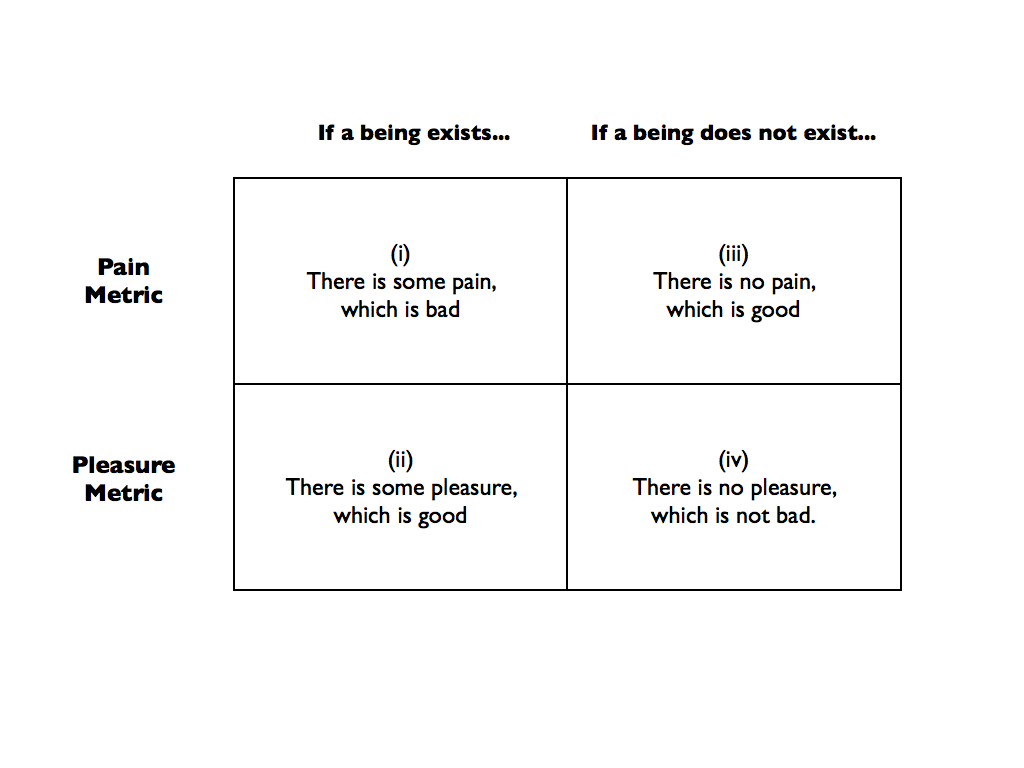
Benatar’s argument hinges on what he calls the “Asymmetry” between pleasure and pain when evaluating procreation:
- The presence of pain is bad.
- The presence of pleasure is good.
- The absence of pain is good, even if no one experiences that good.
- The absence of pleasure is not bad unless there is someone deprived of it.
From these premises, he concludes that nonexistence is preferable, as it guarantees the absence of suffering without depriving anyone of joy, since there is no one to miss it.
This is the elegant skeleton of antinatalism, and its weakness.
The Metaphysical Error
Benatar’s asymmetry rests on a metaphysical assumption inherited from Western dualism. The belief that pleasure and pain are discrete, quantifiable entities that can be compared across the binary of existence and nonexistence. From an Africentric or Eastern metaphysical view, this framework collapses. It mistakes Being for arithmetic and life for transaction.
Life is not a cost-benefit problem.
It is a field of consciousness unfolding through relationship, karma, and evolution. To ascribe moral value to “nonexistence” is to project meaning onto what has no predicates.
Nonexistence is not a state.
It contains no subject, no relation, no awareness through which “good” or “bad” could even arise.
From an Ubuntu-oriented ontology (community-oriented worldview), existence itself is relation, “I am because we are.” To imagine “non-being” as morally superior is to commit what I call the category error of Western nihilism. The illusion of a neutral, external vantage point outside the web of consciousness. In a relational cosmos, there is no outside. Value and possibility are generated only through participation.
Ethics Cannot Escape Ontology
Benatar insists his claim is ethical, not metaphysical. But to say “existence is harm” is already a metaphysical statement. Every ethic presupposes a worldview...what beings are, what life means, and what reality is for. His supposed neutrality hides a metaphysical commitment...that life is a meaningless container of sensations, rather than a sacred unfolding of consciousness.
The deeper question, then, is not "Is existence harmful?" but "What kind of world emerges when we see existence as harm?"
Part Two: Pain, Meaning, and the Delusion of Nonexistence
Benatar’s framework assumes pain is intrinsically bad and that, while meaning might come from it, meaning cannot redeem its badness. This depends on a modern illusion...that value can exist apart from context and awareness.
Across African, Buddhist, and Indigenous cosmologies, pain is not an ethical failure but a pedagogical force....a teacher, an initiator, the heat through which raw consciousness becomes refined. Pain without awareness is bondage. Pain met with awareness becomes transformation.
To call suffering “intrinsically bad” is to moralize the very process by which consciousness matures. Pain is not a moral substance, it is feedback, an instrument of evolution. The true harm is not suffering itself but meaninglessness, the refusal to translate pain into wisdom.
Compassion, Consent, and the Continuum of Being
Benatar’s ethics of compassion revolve around preventing suffering. Yet true compassion is not the avoidance of pain but the liberation that moves through pain. It does not end sentience; it deepens it.
He also argues from consent. Since no one can be asked whether they wish to exist, it is unethical to impose existence. However, this presupposes a dualism between creator and created. In a metaphysical idealist and Africentric view, there is no such separation. Life does not come from outside; it arises within consciousness itself. Birth is not a unilateral imposition but the manifestation of pre-existent relational energy.
The unborn are not “rescued” by nonexistence; they are unmanifested aspects of Being awaiting expression. To deny manifestation out of fear of harm interrupts the circulation of Spirit...the cosmic rhythm of becoming.
The True Meaning of Harm
For Benatar, harm is simply the presence of pain. For a relational metaphysics, harm is misalignment, the Yurugu delusion of separateness that fragments Being. Nonexistence cannot heal that delusion; it merely prevents its transcendence. Only embodied life provides the friction through which consciousness remembers itself.
Life, then, is not a wound to be avoided but the classroom through which Spirit comes to know its own depth.
Logic Without Ontology
Benatar’s arguments are logically consistent yet ontologically hollow. Ethics stripped of metaphysics becomes bureaucratic morality: a calculus of pain without a sense of purpose. It is what Achille Mbembe might call necropolitical reasoning, the governance of life by fear of death.
The real asymmetry is not between pleasure and pain but between intellectual coherence and existential wholeness. Logic can describe patterns, but it cannot confer meaning.
Existence, when seen relationally, is sacred participation. The question is not “Should life exist?” but “Under what conditions can life flourish in alignment?”
Part Three: Context, Culture, and the Yurugu Mind
The Philosopher and His Tunnel
Benatar keeps a tidy faceless digital presence and rarely discusses his private life. In an interview with Sam Harris, (whom I do not respect), Harris tried almost immediately to link Benatar’s pessimism to pathology. Benatar refused, insisting that his mental state is irrelevant to his arguments.
Both moves reflect a deeper fracture in Western thought. Harris assumes despair must equal illness, while Benatar assumes reason can be isolated from biography.
Both enact what Marimba Ani, in Yurugu: An African-Centered Critique of European Cultural Thought and Behavior, calls the Yurugu consciousness...the disembodied, abstracted rationality born of Europe’s metaphysical split between intellect and relation, spirit and matter, word and flesh.
I reject that split. A philosopher cannot be separated from their philosophy. The idea that we can engage “pure ideas” apart from the conditions that produced them is itself a Western illusion. Ayn Rand’s ideas mirrored her traumas and her ideology of rugged atomism, while Benatar’s mirror the alienation of Western secular consciousness.
This is not ad hominem, it is ontology. Every thinker lives within a reality tunnel, to borrow Robert Anton Wilson’s term. This is a perspectival filter shaped by culture, trauma, and cosmology. Pretending one can reason outside of one’s tunnel is merely to inhabit the tunnel of disembodied rationalism.
Benatar’s antinatalism is one such tunnel, rigorous, consistent, and sterile. His refusal to situate his ideas in the soil of experience does not make them wrong, only incomplete.
Thinking from the Wound
I do not believe mental illness invalidates philosophy. To assume so is sanism, an epistemicide (invalidation and killing off of typically non-white knowledge systems) of those who think from the wound. Sanism discredits the knower instead of interrogating the world that made their knowing necessary. It pathologizes insight born of alienation, dismissing it as a symptom rather than revelation. It says that only the mentally well people's perspective is valid, which is problematic, as what is considered mentally ill is not static and unchanging and has never been static or unchanging, and even if it was static and unchanging, it would not invalidate their ability to know things as those who are immersed in something tend to know that structure the best on an embodied level.
When people ask Benatar about his mental health, they are really asking whether his proximity to suffering makes his view unreliable. Yet proximity to suffering gives philosophy its existential weight. To think from the wound is not to be irrational, it is to be embodied.
Benatar’s deflection protects his ideas from an audience that conflates despair with delusion, but it also mirrors the Western pathology of separation, the refusal to see thought as incarnate, as ancestral, as socially embedded. In Africentric frameworks, philosophy is not abstract speculation but lived cosmology...ideas grow from lineage, trauma, joy, and love alike.
Every philosopher is a symptom of their civilization, and, at best, a response to its sickness. The real question is not “Is Benatar mentally ill?” but “What kind of world makes Benatar’s conclusion feel reasonable?”
His pessimism is the logical endpoint of a civilization alienated from wholeness, a world that teaches consciousness to see itself as accident rather than expression. His philosophy reveals the sorrow of a cosmos perceived through the tunnel of disconnection.
Rather than discredit him, we might thank him. He shows us what happens when intellect is severed from ontology, when a brilliant mind tries to think without belonging.
Balance, Context, and the Ethics of Birth
Benatar is right about one thing: the morality of procreation cannot be abstract. It depends on context. As Steven James Bartlett argues in Normality Does Not Equal Mental Health, much of what passes for “normal” in modern life, even the drive to reproduce, may not necessarily signal wellness but adaptation to dysfunction.
To bring children into a collapsing, extractive, anxiety-ridden civilization may not express flourishing but confusion. In many WEIRD societies (Western, Educated, Industrialized, Rich, Democratic), parenting is prohibitively expensive, socially isolating, and spiritually unsupported. Parents often become anxious sentinels guarding their children from the very dangers they tacitly endorsed by birthing them.
Such creation is not necessarily an act of Maat, the ancient Kemetian principle of balance, truth, harmony, and alignment with the cosmos. Maat is the cosmic equilibrium that sustains order. To live by Maat is to act in alignment with the rhythms of the universe. Birth, under conditions of deep imbalance, may reproduce that imbalance rather than heal it.
Yet this is not a condemnation. My argument remains descriptive, not prescriptive. I am not saying “have children” nor “do not have them.” I am saying that the ethics of birth depend on alignment. In a society rooted in interdependence, birth can be sacred continuity.
Idealism and the Futility of the Debate
From a metaphysical idealist view, even this debate dissolves. If consciousness precedes matter, then what we call “children” exist as potential regardless of manifestation. The soul precedes the body...creation is a mode of participation, not origination. Whether we reproduce biologically or not, Being continues to express itself through infinite relational forms.
In that sense, antinatalism loses coherence, the unborn are not prevented...They are merely unmanifested.
Life as Initiation
Benatar’s philosophy is not evil... it is wounded brilliance. It mirrors a world that has forgotten that Being is sacred participation, not mere endurance. His argument only functions within the metaphysics that birthed it...the Yurugu logic of separation, the reality tunnel of alienated reason.
Once we return to a relational cosmos, where existence is not transaction but transformation, his logic dissolves into tragic poetry...lucid, sincere, but incomplete.
Life, even in its sorrow, is not harm. It is the crucible through which consciousness awakens to itself, endlessly recalibrating the scales of Maat (cosmic balance). The task before us is not to end birth but to end distortion, to midwife lives, systems, and worlds that remember what they are... expressions of a cosmos still becoming.
Part Four: Reiterating for Predictable Responses from Benatar Himself
Philosophers like Benatar often meet metaphysical critiques with an air of polite dismissal. His responses are typically predictable (I've also consumed basically every podcast appearance of his and am really skilled at studying people), not because he lacks depth, but because his framework is self-contained. His worldview, while rigorous, cannot perceive what falls outside its logic. Still, for the sake of intellectual honesty and clarity, it’s worth preemptively addressing how he might respond to this essay, and why those responses fail to land when seen through a broader, relational, and metaphysically integrated lens.
1. “You’ve changed the question from ethics to metaphysics.”
This is perhaps Benatar’s most common deflection. He would likely say that my essay does not engage with the moral question he’s asking, because I’ve reframed it as a question about Being. But to say “existence is harm” is already a metaphysical claim. There is no way to declare something as inherently harmful without assuming a theory of what existence is and how value arises within it.
Ethics cannot exist apart from ontology. Every moral claim carries a hidden cosmology. The difference between us is not that I’ve “shifted the question,” but that I refuse to pretend metaphysics can be escaped. Benatar’s claim to neutrality is itself a metaphysical position, the metaphysics of Western secular materialism, which presupposes a disenchanted cosmos and an atomized self.
In exposing that hidden assumption, I’m not dodging his argument. I’m contextualizing it. I’m showing that the “ethical question” he wants to isolate is already embedded in a worldview that has amputated itself from relation, spirit, and meaning.
2. “Nonexistence doesn’t need to be good, it just lacks harm.”
Benatar would likely say that I’ve misunderstood his asymmetry, insisting that he doesn’t attribute goodness to nonexistence. Rather, he argues that nonexistence is preferable because it contains no suffering.
But this still smuggles moral valuation into a void. To claim that “the absence of pain is good” or even “preferable” is to assign ethical significance to non-being. That’s a category error. Nonexistence cannot be preferable, good, or bad because it is not a state, there is nothing there to which preference can apply.
Benatar’s argument relies on moral comparison between something and nothing, but “nothing” cannot be part of a moral equation. You cannot compare experience to its total absence and pretend it’s neutral reasoning. That’s not logic...that’s necrologic, the logic of a civilization more comfortable with death than with depth.
3. “Pain may be meaningful, but it’s still harm.”
Benatar would concede that suffering can yield insight or growth, but he would argue that this doesn’t justify bringing suffering into existence. He might say: “Just because pain can produce wisdom doesn’t mean we should create beings who will have to suffer to gain it.”
This seems persuasive until you realize it rests on a specific assumption about what life is for. He assumes life exists to maximize pleasure and minimize pain. I don’t. Within an Africentric or even just a metaphysical idealist framework, life exists to participate in the ongoing evolution of consciousness, balance, and alignment. Pain, in this view, is not a cosmic malfunction, it is feedback. It shows where harmony has been lost.
In that sense, pain is not morally bad, it is sacred. Not desirable, but meaningful. Benatar’s claim that “pain is always harm” only makes sense in a universe where consciousness has no purpose. In a relational cosmos, pain has function, direction, and even grace.
4. “Your worldview is unfalsifiable, mine is grounded in reason.”
This is the standard analytic philosopher’s fallback...the belief that “rational” frameworks are objective while metaphysical or spiritual ones are speculative. But reason itself is metaphysical, it depends on assumptions about order, causality, coherence, and intelligibility that cannot be empirically proven.
Benatar’s worldview rests on faith, too...faith in materialism, faith in the separateness of minds, faith in an external reality whose meaning can be measured through logic alone. These are not neutral positions. They are metaphysical commitments, just as mine are. The difference is that I acknowledge mine.
To call metaphysical idealism “unfalsifiable” is to misunderstand philosophy itself. All philosophies depend on unfalsifiable foundations. The only question is whether those foundations lead to coherence or contradiction, to alignment or alienation.
In that sense, my argument does not reject reason... it re-situates it. Logic is a servant of Being, not its master.
5. “You’re romanticizing suffering.”
Another predictable objection. Benatar would accuse me of glorifying pain to make peace with an otherwise cruel world. But this essay doesn’t claim that suffering is “good.” It claims that the existence of suffering is not sufficient grounds to declare existence itself unethical.
There is a profound difference between denial and integration. Denial says: “Suffering doesn’t matter.” Antinatalism says: “Suffering is all that matters.” Integration says: “Suffering is part of the process through which meaning is realized.”
Pain can distort consciousness, but it can also awaken it. Which effect it has depends not on the pain itself but on the relational context, the alignment or misalignment of the being experiencing it. Benatar’s binary logic erases that nuance. It is not suffering but alienation from the meaning of suffering that constitutes harm.
6. “You’re being culturally relativistic.”
Benatar would likely interpret the Africentric dimension of my argument as a form of relativism, that I’m saying Western logic is “wrong” because it’s Western. But that’s not the claim. I’m not rejecting his argument because of its cultural origin...I’m revealing that its assumptions are not universal.
All reasoning is situated. The Yurugu critique, drawn from Marimba Ani’s work, names the specific pathologies of Western abstraction, the elevation of disembodied reason over relation, objectivity over participation, intellect over cosmos. Naming that structure isn’t an ad hominem... it’s meta-philosophy.
The point is not that Benatar is “wrong” because his thinking is Western. The point is that his worldview, born from the metaphysics of separation, cannot perceive the sacred interdependence that renders his conclusion incomplete. His philosophy is internally consistent, but existentially provincial.
7. “Meaning doesn’t cancel harm.”
Here Benatar would likely say that even if one can find meaning in life, that meaning doesn’t erase the harms that come with existence. And he’s right, but that’s not the point. Meaning doesn’t cancel harm, it transfigures it.
Meaning changes the moral valence of experience. It reinterprets pain not as mere injury but as instruction. In that shift, harm ceases to be absolute and becomes relational. What was once “bad” becomes “part of.”
His framework demands a world without harm. Mine accepts a world where harm is metabolized into wisdom, where suffering serves alignment rather than annihilation. These are not degrees of optimism or pessimism, they are different ontologies of value.
8. “You’re not refuting me, you’re reframing me.”
Benatar’s final move would likely be to concede that my position is coherent but to say it’s operating in another dimension of inquiry altogether. He would see this essay as metaphysical poetry, not a refutation of his asymmetry.
To that, I’d agree, partially. I am reframing, not merely refuting. Because the problem is not that Benatar’s argument is wrong within its logic, but that his logic is too small to contain the whole of reality.
I’m not trying to win within his framework. I’m showing the limits of the framework itself.
His question, “Is existence harmful?”, is not a question that can be answered within the vocabulary of harm. It collapses under the weight of its own reductionism. Once we shift from one right way to many right ways, from isolation to relation, from arithmetic to consciousness, the question dissolves.
9. “But compassion demands prevention of suffering.”
Benatar’s final and most sincere defense is that his position is rooted in compassion: to prevent suffering is the highest kindness. I honor the sincerity of that impulse. Compassion without metaphysical depth becomes necropolitical, a logic of mercy that annihilates the very field it seeks to protect.
True compassion is not the prevention of life but the liberation of life from distortion.
It seeks coherence, not erasure.
To end birth to end pain is to confuse the symptom for the source.
The real work of compassion is not to extinguish Being, but to align it.
In Conclusion
All of Benatar’s likely responses return to the same place... the fortress of analytic separation. His philosophy is self-consistent but cosmologically thin. My essay does not refute him within that fortress, it walks out of it.
The key to refuting as a philosopher is to never do it on the other persons terms, because the house always wins.
To refute on the opponent’s terms is to already concede their framing of reality, their definitions, their categories, their rules of inference, their sense of what counts as “proof.” In doing so, you affirm their world even as you disagree with its content. This is why true philosophical resistance isn’t a counter-argument... it’s a reorientation of the ground on which argument is possible.
Because once you leave the walls of material dualism, once you return to relation, to Maat, to the understanding that Being itself is participatory consciousness, Benatar’s asymmetry dissolves. His arguments remain logically elegant, but existentially irrelevant.
In the end, his antinatalism is the moral logic of a world that has forgotten how to belong.
Life, even in its ache, is belonging.


